Fraud Awareness Is the New Growth Lever
Fraud is no longer just a defensive concern. For financial institutions willing to rethink their approach, fraud prevention — paired with Account holder-facing awareness — has become a strategic enabler of growth.
From cost center to strategic advantage
For years, fraud programs were designed primarily to stop losses and satisfy risk requirements. Today, that perspective is changing. When fraud risk is managed effectively, institutions can move faster — not slower.
Strong fraud prevention allows organizations to expand into new products, new geographies, and faster payment rails. It enables higher transaction limits for trusted Account holders and supports real-time payments without unacceptable exposure. In many cases, fraud concerns — not technology — are the blocker preventing growth initiatives from launching.
This represents a fundamental shift from fraud as a cost to fraud as a competitive advantage.
Fraud trust becomes deposit growth
When you demonstrate fraud expertise publicly — not just internally — you create a competitive advantage that directly drives new accounts and deposits. Consumers are overwhelmed by scams, and they increasingly judge financial institutions on one question: “Will this bank or credit union keep me safe?”
Institutions that make protection visible earn trust faster — and trust moves deposits.
This is where fraud awareness becomes more than “education.” It becomes proof of competence. You are signaling: “We see today’s scams. We know how to stop them. And we’ll help you avoid them.” That message spreads faster than rate promotions because it feels personal, immediate, and protective.
How fraud leadership creates account growth
People switch financial institutions for safety
After a fraud scare — or after seeing friends get scammed — consumers look for a safer home. If your institution is visibly proactive, you become the “safe choice” in the market.
Word-of-mouth becomes a growth channel
“My bank warned me before I sent money” is a story people share. Those stories drive referrals because they’re emotional, specific, and credible.
Marketing gets stronger when it’s real
Campaigns perform better when they show practical help: frontline intervention stories, “how we protect you” explainers, and a library of free tools for account holders.
Make it visible: what to market (without sounding alarmist)
- Frontline win stories: “We helped a member pause and verify before sending money.”
- Free tools for account holders: quick checklists, short videos, scam alerts, and step-by-step recovery guidance.
- Simple promises: “We’ll help you slow down, verify independently, and avoid pressure tactics.”
- Proof of commitment: dedicated fraud/safety hub, monthly themes, and consistent community education.
When your institution becomes known as the place that keeps people safe, deposits follow.
Why fraud prevention now differentiates institutions
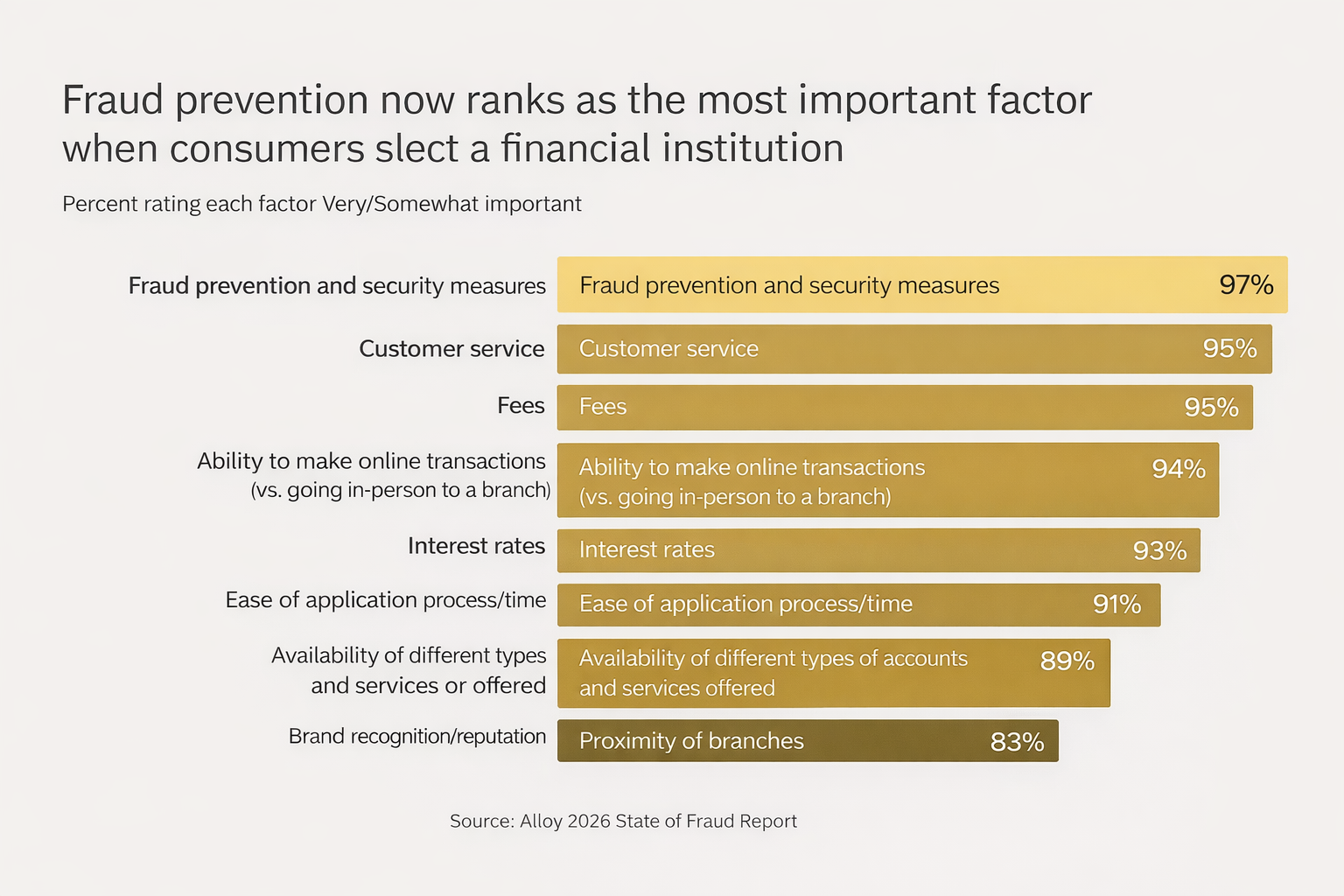
Growth does not occur in a vacuum. It depends on Account holder trust. When consumers evaluate where to bank, fraud prevention and security now rank above traditional factors such as fees, convenience, and branch proximity.
The missing layer: account holder fraud awareness
This shift reframes fraud prevention as a visible signal of institutional competence and care — not merely an internal safeguard. While investments in fraud platforms are critical, outcomes are still shaped by Account holder behavior. Modern scams succeed by exploiting moments of uncertainty — a call, a text, a sense of urgency — when no employee is present.
Why awareness matters
Faster adoption
Account holders who understand fraud risks are more willing to use new digital services and payment capabilities.
Reduced friction
Better awareness lowers false alarms and panic responses that lead institutions to unnecessarily tighten controls.
Stronger loyalty
When Account holders feel protected and informed, trust deepens — and relationships expand.
A new question for financial leaders
The industry has moved beyond crisis management. The question is no longer, “How do we survive fraud?” It is now, “How do we use fraud prevention and awareness to grow?”
Institutions that treat fraud awareness as a core growth capability — not just an internal training exercise — will move faster, build deeper trust, and outperform competitors who continue to view fraud solely as a defensive function.
Fraud prevention stops losses. Fraud awareness unlocks opportunity.